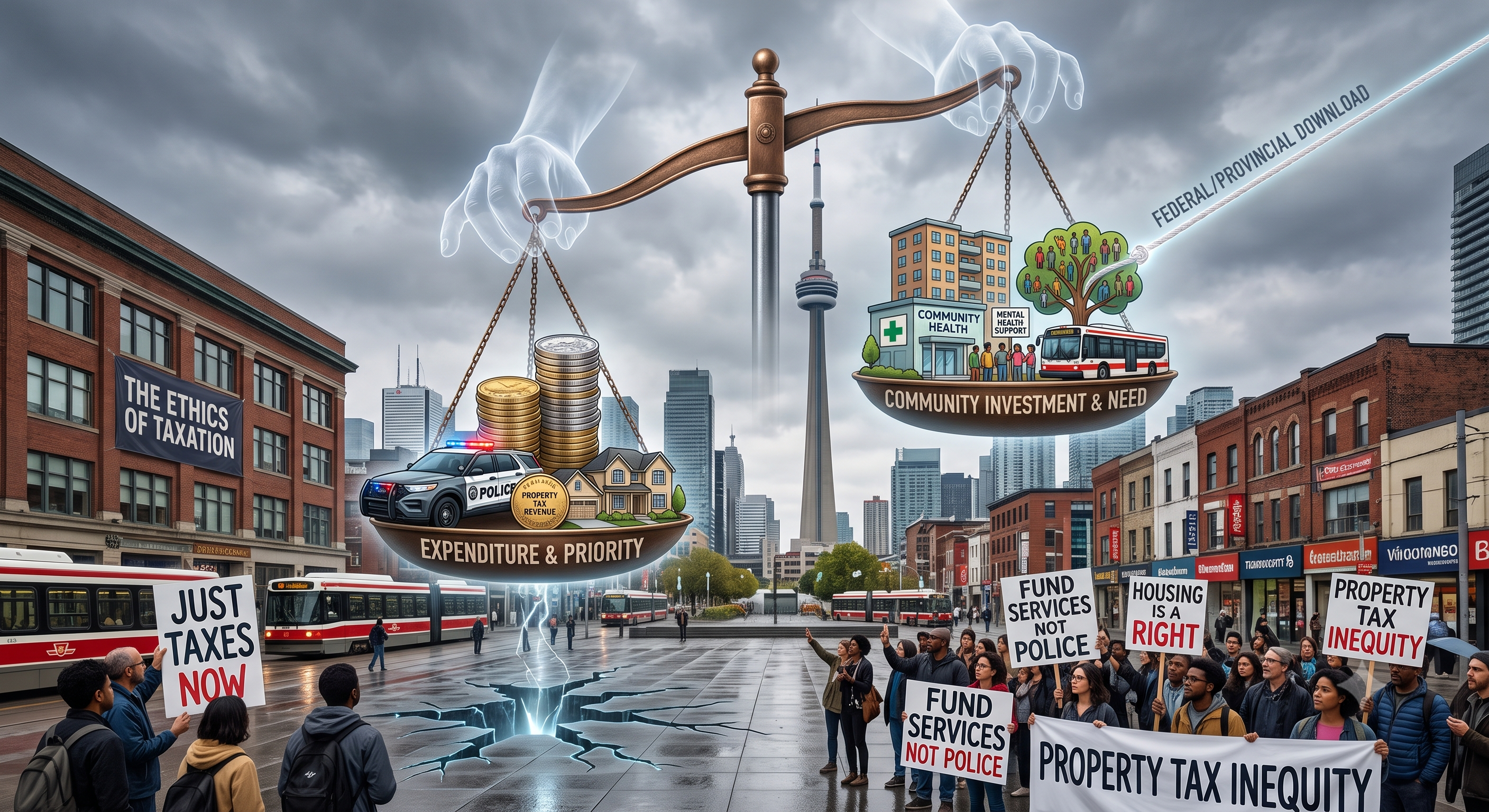
The Ethics of Taxation in Toronto: Structural Inequities, Allocations, and the Common Good
The ethics of paying taxes in Toronto, Canada, is defined by a fundamental friction between a structural revenue model reliant on relatively regressive municipal property taxes and an expanding mandate to address complex, downloaded social crises (housing, homelessness, and mental health). While historical municipal decisions kept Toronto a low-tax haven for property owners at the expense of infrastructure and equity, modern corrections face fierce debates over allocation priority—most notably, the perennial growth of the Toronto Police Service budget over preventative community services.
1. The Structural Architecture: "Creatures of the Province"
Municipalities in Ontario possess no independent constitutional status; under the City of Toronto Act, Toronto is legally a "creature of the province." [1] This constitutional reality shapes the foundational ethics of taxation in the city. Unlike federal and provincial governments, which command progressive tax mechanisms (income, corporate, and sales taxes) that naturally scale with economic growth, Toronto is restricted primarily to property taxes, user fees (e.g., water, solid waste), and land transfer taxes. [1:1]
Nearly 89% of Toronto’s revenue-generating tools do not grow alongside the economy and are strictly confined to rate increases. [1:2]
This creates an ethical mismatch. Toronto is structurally forced to fund localized, systemic human crises via property taxes—a fiscal tool originally designed to pay for tangible, property-related services (roads, snow removal, sewers) rather than deep-rooted socio-economic challenges.
2. The Property Tax Paradox: Low-Tax Haven vs. Regressive Burden
The Historical Austerity Legacy
For over two decades, successive Toronto administrations prioritized keeping residential property tax increases at or below the rate of inflation. [2] This strategy was politically framed as protecting cash-strapped homeowners. However, from an ethical standpoint of distributive justice, it transformed Toronto into a low-tax haven relative to its surrounding Greater Toronto Area (GTA) neighbors (such as Mississauga and Brampton), despite Toronto bearing far denser infrastructure and social service demands. [2:1]
This long-term suppression of revenue resulted in a massive, deferred ethical debt: a multi-billion-dollar "state-of-good-repair" infrastructure deficit across the Toronto Transit Commission (TTC), public parks, and affordable housing stock. [2:2][3]
The Regressivity of the Tax Base
While wealthy property owners benefited from low rates, economic research notes that property taxes are inherently regressive because they do not track immediate household income or fluid capacity to pay. [4] In Toronto, this manifests ethically in two ways:
-
The Tenant Burden: Multi-residential apartment buildings have historically faced disproportionately higher tax rates than single-family homes. [2:3] Landlords routinely pass these tax burdens down to lower-income tenants via Above Guideline Increases (AGIs), meaning renters effectively pay a higher proportion of their income toward municipal taxes than affluent homeowners. [5]
-
The Fixed-Income Trap: Low-income seniors and people with disabilities face immediate financial vulnerability when property taxes are adjusted upward, forcing the city to rely on targeted low-income deferral programs to cushion the blow. [5:1][6]
To remedy this structural deficit, recent city budgets introduced aggressive corrections—including a 9.5% hike in 2024 and a 6.9% hike in 2025, before stabilizing at a more modest 2.2% in 2026. [3:1] Organizations like the Canadian Taxpayers Federation argue these increases are unethical due to severe cost-of-living and inflation pressures squeezing local families. [7] Conversely, civic advocates argue that avoiding these hikes is a failure that starves the collective commons. [5:2]
3. The Allocations War: Policing vs. Upstream Social Services
The most fiercely contested ethical dimension of Toronto taxation centers on where the tax levy is deployed.
The Perennial Expansion of the TPS Budget
In the 2026 municipal budget, the Toronto Police Service (TPS) secured a $93.8 million increase, bringing its net annual budget to an historic $1.43 billion—representing roughly 7.4% of the city’s total operating cost. [8] This expansion is routinely critiqued as an unethical allocation of public capital by community organizations. During city-wide budget consultations, between 40% and 43% of participating Toronto residents explicitly identified police services as their primary target for budget reductions, advocating instead for investments in the root socio-economic causes of crime. [8:1][9]
Toronto has successfully scaled the Toronto Community Crisis Service (TCCS), a non-police civilian alternative responding to mental health distress. Between 2022 and late 2024, the TCCS successfully diverted thousands of wellness calls from 911, resolving 78% of them entirely without police intervention. [8:2] Critics argue that continuing to increase the TPS budget while underfunding alternative models is an unethical misallocation that perpetuates the over-policing and criminalization of racialized, unhoused, and marginalized communities. [8:3][9:1]
4. The Ethics of Downloaded Responsibilities
A glaring ethical conflict in Toronto’s fiscal layout is the systemic downloading of federal and provincial obligations onto the municipal tax base.
In 2026, Toronto’s budget allocated roughly $1.576 billion (over 8% of the entire operating budget) strictly toward "extensions of federal and provincial responsibilities"—specifically emergency shelter systems, refugee support, housing initiatives, and social health services. [1:3]
-
The Ethical Dilemma: Funding macroeconomic crises (such as refugee and asylum seeker settlement or regional homelessness) through local property taxes forces Toronto property owners to fund mandates that should be covered under broad federal or provincial income tax.
-
The Consequences: When senior levels of government withhold structural, long-term funding—leaving Toronto to rely on temporary, crisis-driven intergovernmental transfers—the city is forced to make utilitarian trade-offs, such as drawing down capital reserves to fund immediate shelter survival lines. [1:4][3:2]
5. Taxation as a Behavioral and Democratic Tool
The Vacant Home Tax (VHT)
The ethics of taxation in Toronto also extends into behavioral modification. The city enforces a Vacant Home Tax (VHT), set at 3% of a property's current value assessment. [10] From an ethical perspective, the VHT is not designed as a pure revenue stream; rather, it functions as a tool to deter speculative housing hoarding during an unprecedented shelter crisis. It asserts a civic principle: housing is a primary social good, not an unconstrained speculative asset.
Opaque Governance and Democratic Deficits
Finally, the physical delivery and presentation of the budget present an ethical hurdle to representative democracy. Independent policy analyses from the C.D. Howe Institute criticize Toronto's budgeting practices for being opaque, routinely late, and completely divorced from Public Sector Accounting Standards (PSAS). [11]
Because capital projects appear deceptively expensive on cash-budget slides and past accumulated surpluses are omitted from main budget presentations, citizens are presented with a narrative of absolute municipal insolvency. [11:1] Under "Strong Mayor" powers, budgets can be pushed through with diminished council debate, which critics argue fractures the democratic accountability required to ethically steward public funds. [11:2]
This panel discussion from The Agenda with Steve Paikin on the Toronto Police Budget explores the deeply polarized public debates and systemic ethical tensions between expanding police funding and investing in upstream civilian crisis support.
Social Planning Toronto: Toronto's Annual Budget Pressures and the Role of Senior Orders of Government ↩︎ ↩︎ ↩︎ ↩︎ ↩︎
TVO Today: Nobody likes property taxes, but Toronto turns hating them into an art form ↩︎ ↩︎ ↩︎ ↩︎
CP24: City staff to propose 2.2 per cent tax bump for Toronto property owners in 2026 ↩︎ ↩︎ ↩︎
Institute on Municipal Finance and Governance (IMFG): Property Taxes: Effective, But Regressive? ↩︎
Social Planning Toronto: Reasonable and Responsible Property Taxes to Fund a Better City ↩︎ ↩︎ ↩︎
City of Toronto: City of Toronto's 2026 Budget now final — focuses on affordability, service stability and financial sustainability ↩︎
Canadian Taxpayers Federation: Taxpayers call on Toronto city councillors to reject Chow's massive tax hike proposal ↩︎
Social Planning Toronto: Toronto Police Service: The One City Budget Line That Never Stops Growing ↩︎ ↩︎ ↩︎ ↩︎
School of Cities - University of Toronto: Reducing the Burden on Police Services Through Investment in Promoting Healthy Communities ↩︎ ↩︎
Aird & Berlis LLP: Toronto Tax Increases, Provincial Deadlines and Tax Relief Options ↩︎
C.D. Howe Institute: Opaque, Confusing and Late – Toronto's Budget Mess Continues ↩︎ ↩︎ ↩︎